
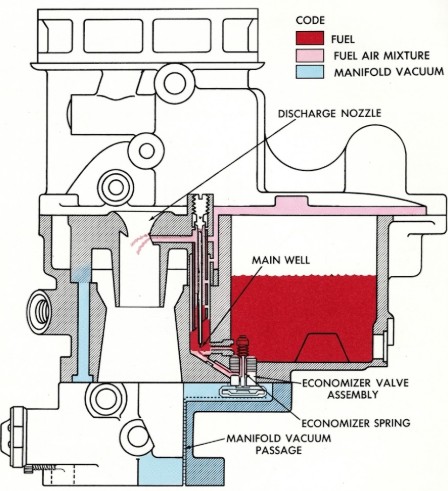
The Holley 2110 (often referred to as part of the Model 94 family) uses a vacuum-operated power circuit to provide the extra fuel required during high-load or high-speed operation. Because the main metering system is calibrated for lean cruising to save fuel, the power circuit acts as a "chemical supercharger," richening the mixture when the engine needs it most.
Here is a breakdown of how the circuit functions:
1. The Vacuum Balance
The heart of the system is the power valve assembly (or economizer valve), located in the bottom of the float bowl. This valve is held closed by engine vacuum during normal idling and light-throttle cruising.
-
High Vacuum (Cruising): When the engine is under light load, manifold vacuum is high. This vacuum pulls the power valve diaphragm upward against the tension of a calibrated spring, keeping the valve seated and closed. In this state, fuel only flows through the main jets.
-
Low Vacuum (Acceleration): When you open the throttle to accelerate or climb a hill, the manifold vacuum drops. When vacuum falls below the specific rating of the power valve spring (e.g., $7.5" \text{ Hg}$), the spring overcomes the weakened vacuum and pushes the valve open.
2. The Fuel Path
Once the power valve is pushed open, it uncovers additional fuel passages in the carburetor body:
-
Fuel Intake: Fuel from the float bowl enters the open power valve.
-
Power Restrictions: The fuel passes through two calibrated orifices known as Power Jet Restrictions. These are fixed holes that determine exactly how much extra fuel is added to the mixture.
-
Mixing: This "extra" fuel joins the fuel already flowing through the main metering wells.
-
Discharge: The combined, enriched mixture travels up to the main discharge nozzles and into the venturi, where it atomizes with the incoming air.
3. The Role of the Diaphragm
In the 2110, the power circuit is strictly vacuum-actuated, unlike some later carburetors that used mechanical rods. This makes the condition of the diaphragm critical.
-
The Leak Risk: If the diaphragm ruptures, manifold vacuum will pull raw fuel directly from the float bowl into the intake manifold through the vacuum passage. This results in an extremely rich mixture, fouled spark plugs, and poor idling, regardless of how the needle valves are adjusted.

Summary of Operation
Tech Tip: When troubleshooting a Holley 2110 that "stumbles" or "bogs" specifically during the transition from cruising to hard acceleration, the power valve is often the primary culprit—either the spring is the wrong rating for the engine's vacuum profile, or the valve itself is gummed up and failing to open.
How Does the Holley 2110 Power Valve Work?
The Holley 2110 "Power Valve" (technically called the Economizer Valve) is a vacuum-operated enrichment circuit. Its job is to provide extra fuel only when the engine is under a heavy load—such as climbing a hill or flooring the gas—allowing you to run leaner, fuel-saving jets during normal cruising.
Here is a breakdown of how the system works based on the diagram:
1. The "Cruise" Phase (High Vacuum)
When you are idling or driving at a steady speed, the engine creates high Manifold Vacuum.
The Path: This vacuum travels up through the Manifold Vacuum Passage (shown in blue in the colorized image).
The Action: The vacuum "pulls" against the Economizer Spring, holding the Economizer Valve tightly closed.
The Result: Fuel is restricted to the main jets only. This "economizes" fuel by preventing the extra enrichment circuit from adding gas when the engine doesn't need it.
2. The "Power" Phase (Low Vacuum)
When you open the throttle wide to accelerate, the manifold vacuum drops significantly because the engine is gulping air.
The Action: With the vacuum gone, it no longer has the strength to hold the valve shut. The Economizer Spring takes over and pushes the valve open.
The Path: Fuel (shown in red) flows from the Float Bowl, through the open valve, and into the Main Well.
The Result: This extra fuel travels up to the Discharge Nozzle and mixes with air to create a richer Fuel-Air Mixture (pink). This richer mixture is necessary to prevent "pinging" (detonation) and to provide the extra horsepower needed for heavy loads.
Key Components from your Image:
Component Function Main Well The primary "holding tank" where fuel is prepared before being sucked into the engine. Economizer Valve The gatekeeper. It stays closed during high vacuum (cruise) and opens during low vacuum (power). Economizer Spring Calibrated to a specific "rating" (e.g., 7.5). It determines at exactly what vacuum level the extra fuel will kick in. Discharge Nozzle Where the final enriched mixture is sprayed into the air rushing through the carburetor. Pro Tip: If your Holley 2110 is running extremely rich or blowing black smoke at idle, the most common culprit is a blown power valve diaphragm. If the internal seal fails, fuel will leak directly through the vacuum passage into the engine, regardless of how much vacuum is present.
