
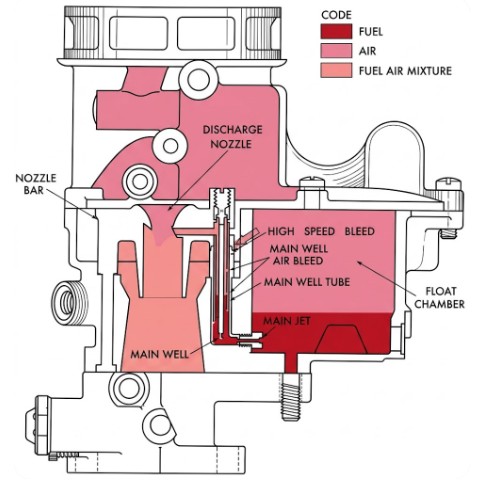
Main Metering System Operation
The Main Metering System in the Holley Model 2110 carburetor is responsible for delivering the proper fuel-air mixture during normal cruising and higher-speed engine operations
-
Pressure Differential: As the engine runs, the intake stroke of the pistons draws air through the carburetor venturi and booster venturi
. The air passing through these restricted areas creates a low pressure (vacuum) . -
Fuel Flow: The difference between the low pressure in the venturi and the atmospheric pressure in the float chamber forces fuel to flow through the main jet and into the main well
. -
Air Bleeding: As fuel moves up the main well, it passes the main well air bleed, where air is added to the raw fuel
. The amount of air added increases proportionally with engine speed . -
Vaporization: This lighter mixture of fuel and air responds more quickly to pressure changes and vaporizes more readily than raw fuel when it is finally discharged
. Discharge: The fuel-air mixture travels through a horizontal channel and is released through the discharge nozzle into the booster venturi, where it joins the primary air stream
.
Control and Distribution
-
Engine Regulation: The throttle plates regulate the total amount of this mixture allowed into the intake manifold, thereby controlling the speed and power output of the engine based on accelerator pedal movement
. -
Anti-Percolation: The design of the booster venturi nozzle bars features a large main well with a long vertical rise
. This design helps minimize "percolation" (fuel boiling on hot days) by allowing vapor bubbles to break before they can carry raw liquid fuel into the discharge nozzle .
Component Summary
Meters the raw fuel entering the system from the float chamber.
Introduces air into the fuel stream to aid in vaporization.
Increases air velocity to create a stronger vacuum for more precise fuel distribution.
Provides a reservoir for fuel and allows vapor bubbles to dissipate to prevent flooding.
