
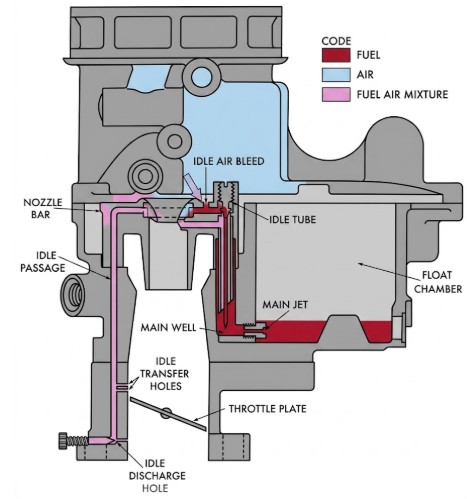
Holley 2110 Idle System Overview
The Holley 2110 (often found on vintage Ford and Studebaker engines) utilizes a low-speed (idle) circuit to provide the necessary fuel-rich mixture when the throttle plate is nearly closed. At this stage, there isn't enough airflow through the venturi to pull fuel from the main nozzle.
The system operates through the following stages:
1. Fuel Pick-up and Metering
-
Main Well to Idle Tube: Fuel is drawn from the Float Chamber, through the Main Jet, and into the Main Well.
-
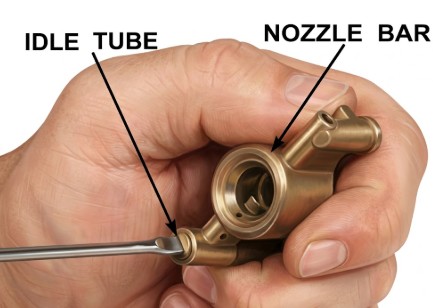
Idle Tube: A vertical Idle Tube extends down into the main well. Manifold vacuum pulls fuel up through this tube.
2. Air Bleeding and Emulsification
-
Idle Air Bleed: As fuel travels upward, it passes the Idle Air Bleed. This introduces a small amount of atmospheric air into the fuel stream.
-
Emulsification: This "bleeds" the vacuum, breaking the liquid fuel into a lighter, bubbly Fuel-Air Mixture. This makes the fuel easier to atomize and prevents the circuit from "siphoning" once the engine is shut off.
3. The Transfer Phase
-
Idle Passage: The mixture travels through internal channels (the Nozzle Bar and Idle Passage) toward the throttle body.
-
Idle Transfer Holes: These are small slots or holes located just above the Throttle Plate.
-
As the throttle begins to open, these holes are exposed to manifold vacuum, providing additional fuel to prevent a "stumble" or flat spot before the main system takes over.
-
4. Final Discharge
-
Idle Discharge Hole: This is the primary exit point located below the throttle plate.
-
Idle Mixture Screw: The volume of the mixture entering the engine at idle is regulated by a tapered needle screw (shown at the bottom left). Turning this screw adjusts the "lean" or "rich" quality of the engine's idle.
