
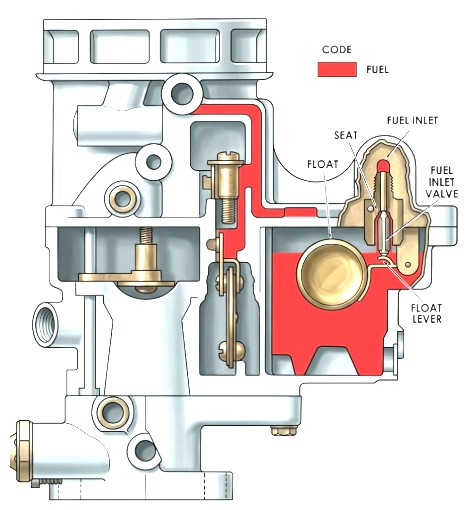
1. Fuel Entry: The Inlet and Float System
The process begins at the Fuel Inlet, where pressurized fuel from the fuel pump arrives at the carburetor.
-
The Needle and Seat: Inside the inlet is the Fuel Inlet Valve (needle) and its Seat. When the fuel level in the bowl is low, the Float drops.
-
Leverage: As the float drops, the Float Lever moves away from the needle, allowing fuel to flow past the seat and into the bowl.
-
The Shut-off: As the fuel level rises, the float buoyantly lifts. The lever pushes the needle back into the seat, cutting off the flow. This maintains a constant "static" level of fuel, which is critical for consistent tuning.
-
2. The Role of Engine Vacuum
Once fuel is sitting in the bowl, it needs a reason to move. That reason is Pressure Differential created by the engine's intake stroke.
-
The Intake Stroke: As the engine's pistons move down, they create a low-pressure area (vacuum) in the intake manifold and the throat of the carburetor.
-
Atmospheric Pressure: The fuel bowl is vented to the atmosphere. Because the pressure inside the carburetor throat is now lower than the air pressure pushing down on the fuel in the bowl, the fuel is "pushed" toward the area of lower pressure.
3. The Venturi Effect
The Holley 2110 features a narrowed section in the center of the barrel known as the Venturi.
-
Velocity Increase: According to Bernoulli's Principle, as air is forced through this narrow restriction, it must speed up.
-
Pressure Drop: This increase in air velocity causes a significant localized drop in air pressure right at the narrowest point of the venturi.
-
The Discharge Nozzle: The main fuel circuit terminates at a discharge nozzle located precisely in this low-pressure zone.
-
4. Atomization and Delivery
Because the pressure in the venturi is much lower than the pressure in the fuel bowl, fuel travels up through the Main Well, mixes with a small amount of air (via air bleeds to help "break" the surface tension), and is pulled out of the nozzle.
As the fuel hits the high-speed airstream in the venturi, it atomizes—turning from a liquid stream into a fine mist. This combustible mixture then travels down past the throttle plate and into the engine's cylinders to be ignited.
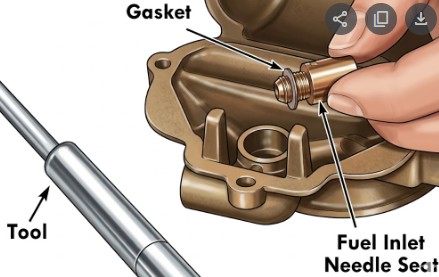
Note: The Tool is not available. Use the widest screw driver that you have.
