
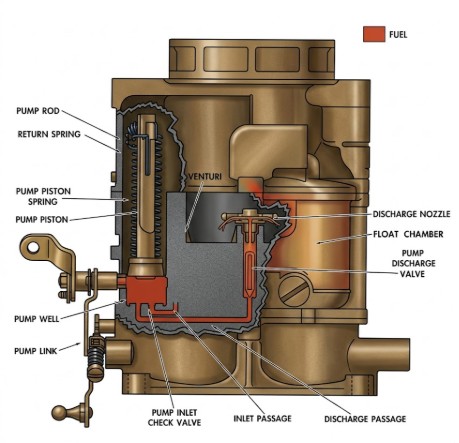
The accelerator pump circuit in a Holley 2110 (often referred to as the "bug eye" or "94" style carburetor) is a mechanical system designed to provide an extra "shot" of fuel when the throttle is opened quickly. This prevents a momentary "lean stumble" because air reacts faster to throttle changes than heavy liquid fuel does.
Here is the step-by-step breakdown of the process:
1. The Intake Stroke (Filling the Well)
When the engine is at idle or steady cruise, the Return Spring pushes the Pump Piston upward. This creates a vacuum in the Pump Well.
-
Fuel flows from the Float Chamber through the Pump Inlet Check Valve.
-
The vacuum lifts the check ball (or disc), allowing the well to fill completely with fuel.
-
At this stage, the Pump Discharge Valve remains seated by gravity or a small weight to prevent air from being sucked back into the system.
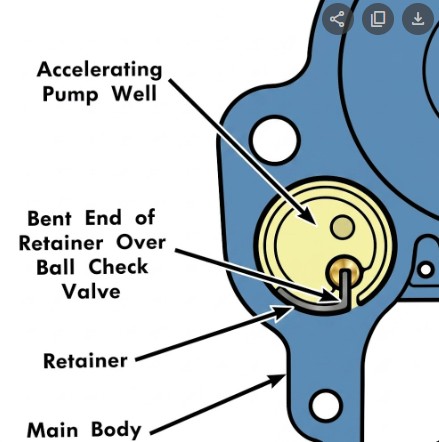
2. Mechanical Activation
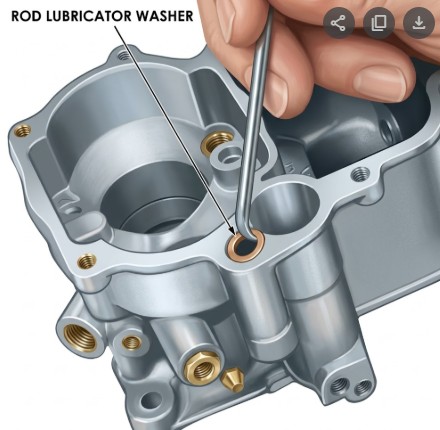
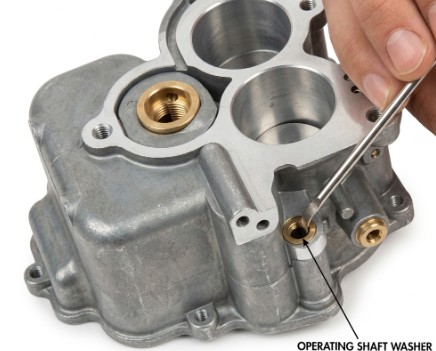
The pump is linked directly to the throttle shaft via the Pump Link and Pump Rod. When you step on the gas pedal:
-
The linkage forces the Pump Rod and Pump Piston downward into the fuel-filled well.
-
The sudden increase in pressure immediately seats the Pump Inlet Check Valve, preventing fuel from escaping back into the float chamber.
3. The Discharge Stroke (The Fuel Shot)
As the piston moves down, the pressurized fuel has only one path to take:
-
It travels through the Discharge Passage.
-
The pressure lifts the Pump Discharge Valve (a needle or ball).
-
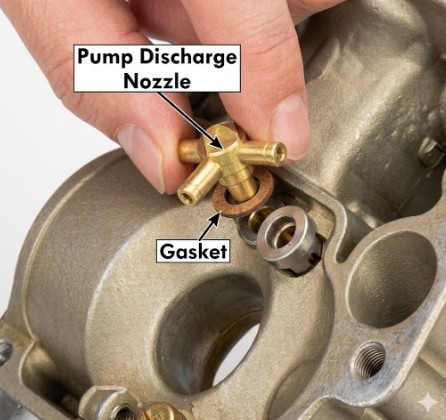
Fuel is then forced out of the Discharge Nozzle (the "shooter"), which is located over the Venturi.
-
This spray of raw fuel enriches the air-to-fuel ratio instantly, allowing the engine to accelerate smoothly until the main metering system can take over
4. The Duration Spring (Smoothing the Flow)
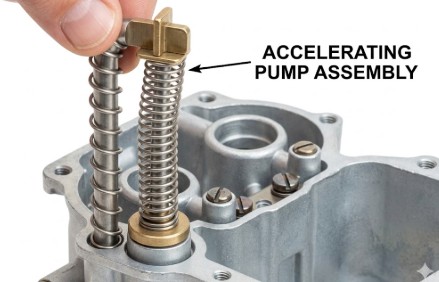
A critical component is the Pump Piston Spring (often located on the rod itself). If the piston were moved solely by rigid metal, the fuel would exit in one violent, instant burst.
-
Instead, the linkage compresses this spring, which then applies steady pressure to the piston.
-
This ensures the fuel "shot" lasts for a second or two, providing a sustained enrichment rather than a single splash.
Summary of Key Components
| Component | Function |
| Pump Well | The reservoir that holds the "standby" fuel shot. |
| Inlet Check Valve | One-way valve that lets fuel in but blocks it from leaving during a stroke. |
| Discharge Valve | Prevents fuel from trickling out during cruise and air from entering during the intake stroke. |
| Discharge Nozzle | The calibrated orifice that determines the direction and intensity of the spray. |
