
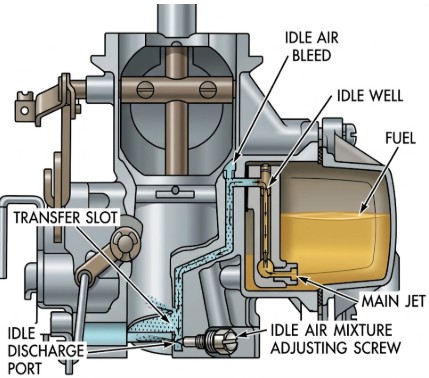
What Does The Transfer Slot Do?
On the Holley 1920 (a classic 1-barrel carburetor commonly found on Chrysler Slant-6 engines), the transfer slot acts as a bridge between the idle circuit and the main metering system.
Think of it as the "hand-off" point that keeps the engine from stumbling when you transition from standing still to moving.
Key Functions
-
The Transition Bridge: When you are at a stop, the throttle plate is nearly closed, and fuel comes only from the tiny Idle Discharge Port. As you press the gas pedal, the throttle plate swings open and uncovers the Transfer Slot.
-
Preventing Hesitation: Without this slot, there would be a "lean spot" (a moment where the engine gets too much air and not enough fuel) before the engine speed is high enough to pull fuel from the main nozzle. The slot provides that extra fuel needed during the first few degrees of throttle opening.
-
Supplementary Fueling: It uses the same fuel "well" as the idle circuit, but because it is a long vertical slot, it progressively reveals more surface area as the throttle opens, smoothly increasing the fuel flow.
Tuning Tip: The "Square" Rule
If you are looking at the bottom of the carburetor with the throttle closed, the amount of the transfer slot visible below the throttle plate should look like a small square (roughly .020").
-
Too much slot visible: Your idle speed is likely set too high by the screw, which "robs" the idle mixture screw of its effectiveness and can cause a rich stumble.
-
Too little slot visible: The engine will likely hesitate or "flat spot" the moment you touch the gas because the fuel won't start flowing quickly enough.
