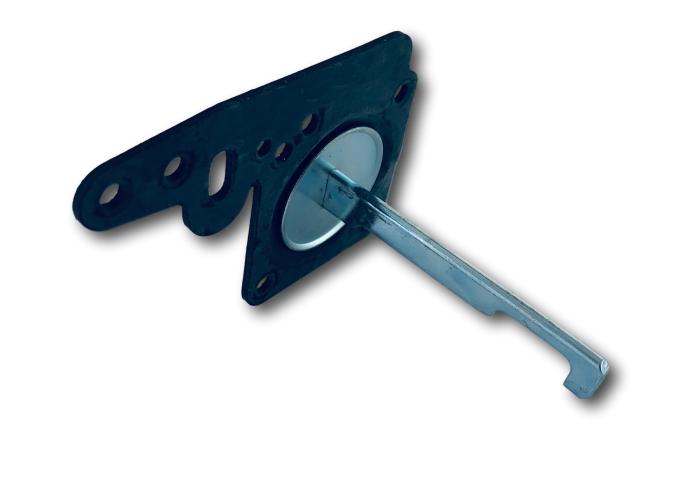
The Holley 1920 carburetor, like many other carburetors, has an accelerator pump circuit designed to deliver an extra shot of fuel when you press the accelerator pedal quickly. This circuit helps prevent hesitation and stumbling in the engine's performance when you suddenly demand more power.
Here's how the accelerator pump circuit in a Holley 1920 carburetor works:
-
Accelerator Pump Diaphragm: The circuit starts with an accelerator pump diaphragm located in the carburetor. When you press the accelerator pedal, it activates a lever that pushes on this diaphragm.
-
Diaphragm Movement: As the diaphragm returns it creates a suction effect that draws fuel from the carburetor's float bowl.
-
Fuel Delivery: The drawn fuel is then delivered through a small passage or nozzle and into the carburetor's main venturi. The main venturi is where the air and fuel mix before entering the engine's cylinders.
-
Enrichment: This sudden injection of extra fuel enriches the air-fuel mixture, providing a quick burst of fuel to match the increased air flow caused by pressing the accelerator pedal. This prevents a lean condition that could cause hesitation or bogging when accelerating.
-
Smooth Transition: The accelerator pump circuit is designed to provide a smooth and linear increase in fuel delivery, ensuring that the engine responds to throttle input without stumbling or hesitation.
Inlet Check Ball: When stepping on the gas the inlet check ball is forced to seat not allowing gas to flow back to the fuel bowl.
Pump Discharge Check Valve: When not accelerating, this check ball is seated so that fuel is not siphoned into the bore. If you are getting gas accumulating in the intake then this may be the problem.
In summary, the accelerator pump circuit in a Holley 1920 carburetor is a crucial component for ensuring smooth acceleration and preventing engine hesitation. It provides a momentary increase in fuel flow when you press the accelerator pedal, helping maintain the engine's performance during rapid throttle changes.



The main discharge (often referred to as the main nozzle) on a Holley 1920 carburetor is the primary point where fuel enters the air stream during cruising speeds. It acts as the transition point between the fuel bowl and the engine's intake manifold once you have moved past the idling phase.
Primary Function
The main discharge is responsible for delivering a metered amount of fuel into the venturi when the engine is under load or operating at steady speeds (typically above 20–25 mph).
How it Works
-
Pressure Differential: As air passes through the narrow part of the carburetor (the venturi), its velocity increases and its pressure drops.
-
Fuel Draw: This low pressure creates a suction effect (the Bernoulli principle) that pulls fuel up through the main well, past the main jet, and out through the main discharge nozzle.
-
Atomization: As the fuel exits the nozzle into the fast-moving air, it breaks into a fine mist. This "atomized" mixture is necessary for efficient combustion in the cylinders.
Key Characteristics of the 1920 Design
-
The "Economizer" Circuit: The main discharge works in tandem with the economizer (power valve) circuit. At high vacuum (cruising), the fuel is restricted to maintain a lean, fuel-efficient mixture. When vacuum drops (acceleration), more fuel is allowed to reach the main discharge.
-
Positioning: On the Holley 1920—a single-barrel, "basket-style" carburetor—the discharge nozzle is typically a small tube or passage that extends into the center of the venturi to ensure the fuel is dropped into the area of highest air velocity.
-
Anti-Siphon: The circuit includes "air bleeds" that mix small amounts of air with the fuel before it reaches the discharge nozzle. This prevents the fuel from "siphoning" out of the bowl when the engine is off and helps pre-mix the fuel for better atomization.
Why it Matters
If the main discharge is clogged or the air bleeds are dirty, you will likely experience:
-
Flat spots or "stumbling" when transitioning from a stop to cruising speed.
-
Poor fuel economy if the air bleeds aren't mixing enough air with the fuel.
-
Engine surging at steady speeds.