The Holley 1904, often nicknamed the "glass bowl" carburetor due to its distinctive glass fuel chamber, is a classic piece of mid-century engineering. While it is a relatively simple single-barrel carburetor, its accelerator pump circuit is vital for smooth drivability.
Without this circuit, your engine would likely stumble or "cough" every time you stepped on the gas. Here is a breakdown of how the Holley 1904 handles that sudden demand for fuel.
The "Lean Stumble" Problem
To understand the circuit, you first have to understand the physics of an engine. When you quickly open the throttle, a large gulp of air rushes into the intake manifold. Fuel, being heavier and denser than air, is slower to react. This results in a momentary lean condition (too much air, not enough fuel).
The accelerator pump circuit acts as a mechanical "squirt gun" to bridge that gap, providing an instantaneous shot of raw fuel until the main metering system can catch up.
Components of the 1904 Accelerator Circuit
The Holley 1904 uses a diaphragm-style pump rather than the plunger-style found on many later carburetors. Its key components include:
-
The Pump Diaphragm: A flexible rubber membrane backed by a heavy spring.
-
The Pump Linkage: A mechanical rod connected to the throttle shaft.
-
Inlet Check Ball: A small ball that allows fuel into the pump chamber but prevents it from being pushed back into the fuel bowl.
-
Discharge Check Weight/Ball: Prevents fuel from being sucked out of the pump nozzle by engine vacuum during normal cruising.
-
The Pump Nozzle (Shooter): The small brass tube that directs fuel into the venturi.
How the Circuit Operates
1. The Intake Stroke (Filling)
When you are idling or driving at a steady speed, the diaphragm spring pushes the diaphragm outward. This creates a low-pressure area in the pump chamber. Fuel from the bowl is drawn through the inlet check ball to fill the chamber, ready for the next acceleration.
2. The Pressure Stroke (The Squirt)
When you depress the accelerator pedal, the throttle shaft rotates. Through a series of linkages, this movement overcomes the diaphragm spring and forces the diaphragm inward.
-
The pressure immediately seats the inlet check ball, so fuel can't go back into the bowl.
-
The fuel is forced through a discharge passage, lifting the discharge check weight.
-
The fuel is then sprayed out of the pump nozzle directly into the path of the incoming air.
3. The Follow-Through
Holley designed the linkage with a "duration spring." Instead of a rigid hit that would dump all the fuel in a microsecond, the spring allows for a slightly sustained "squirt." This ensures the extra fuel lasts long enough for the engine's RPM to climb and the main venturi vacuum to take over fuel delivery.
Common Issues and Maintenance
Because the 1904 is an older design, the accelerator circuit is often the first place to look if the vehicle is performing poorly.
-
Dried Diaphragms: Modern ethanol fuels can cause the old rubber diaphragms to stiffen or crack. If the diaphragm leaks, you lose your "squirt" and may even leak fuel externally.
-
Clogged Nozzles: Because the discharge nozzle is very small, tiny bits of debris or "varnish" from old gas can block it entirely.
-
Stuck Check Balls: If the inlet check ball doesn't seat, the fuel just pumps back into the bowl instead of down the throat of the engine.
If you ever find your vintage Ford or International Harvester hesitating when you pull away from a stoplight, the 1904's "squirt gun" is almost certainly the culprit!
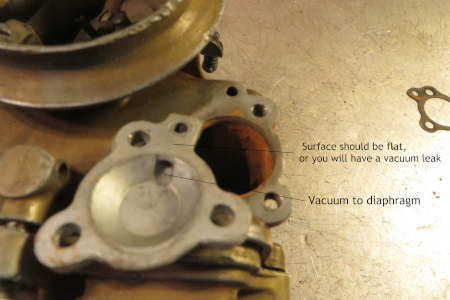
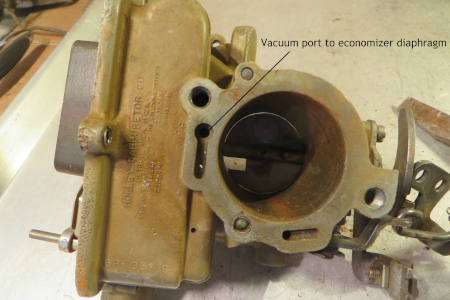
- This could be caused by the power valve remaining open too much. The economizer cover could be warped allowing vacuum to escape.
- A stuck power valve stem would cause the same problem.
- Make sure the choke valve is fully open when the engine is at operating temperature. It could be out of adjustment, bad thermostat, or bad choke spring.
- Make sure the discharge check ball is clean and loose.