
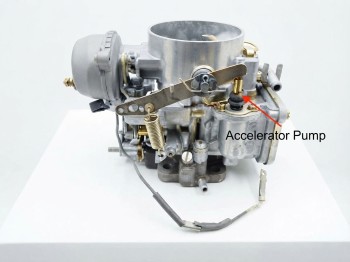
On vintage Hitachi carburetors (commonly found on Nissan/Datsun, Toyota, and Mazda vehicles), the accelerator pump system serves a single critical purpose: preventing an engine stumble or bog during sudden acceleration.
When you snap the throttle open from an idle or low cruise, air rushes into the engine instantly, but liquid fuel is heavy and takes a split-second longer to catch up. This momentary lag creates a lean condition. The accelerator pump acts as a mechanical squirter to bridge that gap.
The internal mechanical sequence operates through several distinct steps:
1. Mechanical Actuation (The Linkage)
Unlike some carburetors that use a plunger style pump, most automotive Hitachi carburetors utilize an external rubber diaphragm housed under a cover on the side or front of the float bowl.
-
As you press the gas pedal, the throttle shaft rotates.
-
A mechanical linkage arm connected to the throttle shaft presses against the accelerator pump's operating lever.
2. Pumping the Fuel (The Diaphragm Stroke)
-
The lever pushes inward against a spring-loaded metal cap, which forces the rubber diaphragm to flex inward toward the pump cavity.
-
This movement pressurizes a small reservoir of fuel trapped behind the diaphragm.
3. Controlling the Flow (Internal Check Valves)
To ensure the fuel goes in the right direction, the circuit relies on tiny check valves (often a small weight, ball, or flapper valve):
-
When the diaphragm compresses, pressure forces the inlet check valve to snap shut, preventing the fuel from escaping backward into the main float bowl.
-
Simultaneously, that same pressure opens the outlet check valve, forcing the fuel up through internal passages drilled into the main body of the carburetor.
4. The Squirter Nozzle
-
The pressurized fuel is pushed out through a dedicated accelerator pump nozzle (often called a "squirter") positioned to spray a direct stream of raw fuel right into the primary venturi/throat of the carburetor, aimed squarely at the oncoming airstream.
-
This momentary extra shot of fuel enriches the air-fuel mixture just long enough for the engine's main metering circuits and venturi vacuum to catch up.
5. Resetting (The Return Stroke)
-
When you release the gas pedal, the throttle returns to idle, and a return spring pushes the diaphragm back out to its resting position.
-
This creates a minor vacuum inside the pump cavity, pulling the inlet check valve open and refilling the chamber with fresh fuel from the float bowl, making it ready for the next time you step on the gas.
Common Hitachi Troubleshooting Note:
Because Hitachi accelerator pumps rely on a flexible rubber diaphragm exposed to modern fuel, ethanol is their worst enemy. Over time, ethanol dries out and cracks the rubber diaphragm. When a diaphragm develops pinhole cracks or tears, it can no longer build pressure—resulting in an empty pump shot, a severe off-idle hesitation, or a wet exterior fuel leak under the pump cover.

