Possible causes are below, these are the most common possibilities
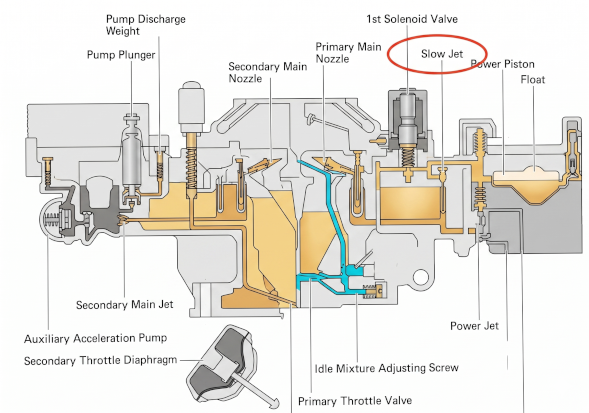
- slow jet clogged
- slow jet not seated properly in main body (if overtightened it will bottom out and if loose it will alter fuel flow)
- carburetor to intake manifold nuts loose (ensure lock washers are installed)
- intake manifold to cylinder head mounting nuts loose
Buy Aisan Carburetor Parts
Other possible causes
- idle screw not adjusted properly
- idle mixture screw not adjusted properly or tapered end worn or damaged - find instructions here
- slow port (idle mixture adjusting screw port) clogged
- primary or secondary throttle shaft worn
- primary or secondary throttle valve misaligned in bore
- idle circuit air bleeds clogged
- incorrect choke plate position (should allow choke to open freely when engine is warm)
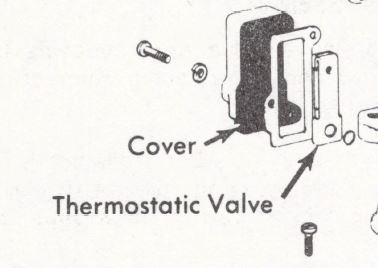
- carburetor thermostatic valve not seating properly
- retard vacuum pipe loose in flange or leaking
- economizer jet passage clogged
- air horn gasket damaged and allowing air to leak into power valve vacuum passage which causes the power valve to open
- secondary throttle valve not closing tightly
Could be caused by the Thermostatic Valve equipped on some vehicles.

As the valve opens, it allows outside air to flow directly into the intake manifold, leaning out the rich air fuel mixture. Valve starts to open when engine compartment temperature reaches 140 F, or 60 C and fully opens at 167 F, 75C.
Adjusting the Aisan Idle Mixture
The idle mixture adjustment on an Aisan carburetor is a crucial element in achieving smooth idling and optimal engine performance. Whether you're a seasoned mechanic or a DIY enthusiast, understanding how to adjust the idle mixture can make a significant difference in the way your vehicle runs. In this guide, we'll walk you through the steps to adjust the idle mixture on an Aisan carburetor.
Tools and Materials You'll Need
Before you start, make sure you have the following tools and materials on hand:
-
Screwdriver: A flathead screwdriver or a screwdriver specifically designed for carburetor adjustments.
-
Tachometer: This will help you monitor your engine's RPM (revolutions per minute) during the adjustment process.
-
Safety Gear: Wear safety glasses and gloves to protect yourself from any fuel or debris.
-
Clean Rags: You may need these to wipe down the carburetor and surrounding areas.
Step 1: Safety First
Safety should always be your top priority when working on your vehicle. Ensure the engine is turned off and cool before you begin.
Step 2: Locate the Idle Mixture Screws
The idle mixture screws on an Aisan carburetor are typically located on the base plate of the carburetor, near the front and rear. You may need to remove the air cleaner housing to access them.
Step 3: Initial Adjustment
Start by gently turning each idle mixture screw clockwise until they are lightly seated. Turn out 1 1/2 turns. This is your initial adjustment position (engine off).
Step 4: Start the Engine
Start the engine and let it idle. Use your tachometer to monitor the RPM. A common target for idle RPM is around 800 to 1000 RPM, but this may vary depending on your specific vehicle and carburetor model. Consult your vehicle's manual for the recommended idle RPM.
Step 5: Adjusting the Idle Mixture
Now, it's time to adjust the idle mixture for the best idle quality. Follow these steps:
-
Front Screw: Begin with the front idle mixture screw. Slowly turn it counterclockwise (outward) until you notice a drop in RPM. Be patient and turn the screw gradually.
-
Rear Screw: Repeat the same process with the rear idle mixture screw. Turn it counterclockwise until you observe a drop in RPM.
-
Balance Adjustment: After adjusting both screws, you may find that the RPM is not where you want it to be. To balance the idle mixture, go back to the front screw and turn it counterclockwise slightly to increase the RPM. Then, adjust the rear screw accordingly to maintain the desired RPM.
-
Repeat as Needed: You may need to repeat this process a few times, making small adjustments to both screws until you achieve a stable idle RPM.
Step 6: Final Check and Cleaning
Once you've achieved the desired idle RPM and a smooth, stable idle, it's time for a final check. Make sure there are no vacuum leaks around the carburetor and that all connections are secure.
Additionally, take a moment to clean the surrounding area and the carburetor itself with a clean rag to remove any dirt or debris.
Step 7: Reassemble and Test Drive
If you removed the air cleaner housing, reassemble it carefully. Reconnect the battery if you disconnected it earlier. Finally, take your vehicle for a test drive to ensure that the adjustments you made have improved its overall performance and drivability.
Conclusion
Adjusting the idle mixture on an Aisan carburetor is a fundamental maintenance task that can significantly impact your vehicle's performance and fuel efficiency. By following these steps and being patient with the adjustment process, you can achieve a smooth and stable idle, helping your engine run at its best. If you're unsure about any step or encounter difficulties, don't hesitate to seek professional assistance from a qualified mechanic familiar with Aisan carburetors.