
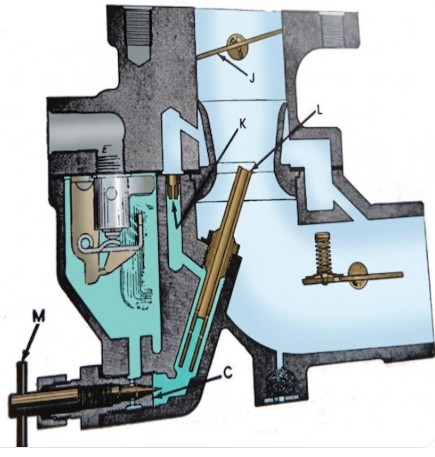
Hard starting on a Carter UT is often a game of "too much fuel" or "not enough fuel." Because these carburetors are common on vintage tractors (like the Ferguson TO-35 or Farmall Super C), they are susceptible to age-related issues like varnish and wear.
Here are the most likely culprits for a hard-starting Carter UT:
1. Cold Start: Choke Issues
If the engine won't fire when cold, the choke (Letter J in your diagram) is the first place to look.
-
Not Closing Fully: If the choke plate doesn't snap completely shut, the vacuum won't be strong enough to pull fuel through the main nozzle.
-
Binding Linkage: Dust and old grease can make the choke sticky. Ensure the cable or lever allows the plate to move freely.
2. Hot Start: Fuel Percolation
This is a very common issue with modern fuels in vintage carburetors.
-
The "Boil Off": After you shut down a hot engine, the heat from the manifold rises into the carburetor. Modern gas has a lower boiling point than fuel from the 1950s; it can actually "boil" out of the nozzle (Letter L) and flood the intake manifold.
-
The Symptom: If you have to hold the throttle wide open to get it to start when hot, it’s likely flooded due to percolation.
3. Clogged Idle Circuit
The Carter UT relies heavily on the idle circuit for starting.
-
Varnish: If the tractor sits for months, gasoline turns to varnish and plugs the tiny passages near the idle mixture screw.
-
The Test: If the engine starts but only runs with the choke partially on, your idle circuit is restricted and needs a thorough cleaning with compressed air and carb cleaner.
4. Float and Needle Issues
As discussed with the float system, if the level is off, starting becomes a chore.
-
Sticking Needle: If the needle sticks closed, no fuel enters the bowl. If it sticks open, it floods.
-
Leaky Float: If the float develops a pinhole and fills with gas, it becomes heavy and sinks, causing the carburetor to flood constantly.
5. Accelerator Pump (If equipped)
While some UT models are simpler, those with an accelerator pump need that "squirt" of fuel to fire up.
-
The Test: With the engine off and the air cleaner removed, look down the throat and move the throttle. You should see a visible stream of fuel. No stream? The pump leather is likely dried out or cracked.
Troubleshooting Checklist
Pro Tip: If you suspect it's flooded, try starting with the throttle wide open and no choke. If it's starving for fuel, try a 1-second burst of starting fluid—if it fires right up, you know you have a fuel delivery problem.
