
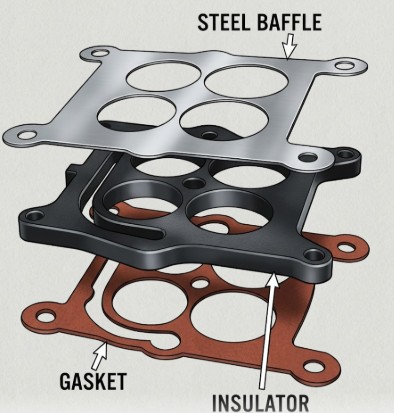
Installing an AFB (Aluminum Fuel Bowl) carburetor on a high-performance 327 engine is a precision task where the sequence of mounting components is just as critical as the torque of the bolts. Getting this stack wrong often leads to immediate driveability issues or long-term damage to the carburetor.
The High-Performance 327 Stack
For the high-performance 327, the assembly is designed to combat two main enemies: heat soak and exhaust gas corrosion. The components must be installed in this specific order, starting from the intake manifold:
Base Gasket: This provides the initial seal against the intake manifold.
Stainless Steel Baffle: This is a thin, contoured plate. Its primary job is to protect the carburetor's aluminum base from the hot exhaust gases that circulate through the intake manifold’s heat riser passage. Without this, the hot gases can actually erode or warp the carburetor base.
Insulator (Heat Spacer): Usually a thicker phenolic or composite material, this acts as a thermal barrier. It prevents engine heat from "soaking" into the carburetor, which would otherwise cause the fuel in the bowls to boil (vapor lock).
Carburetor Gasket: The final seal that sits between the insulator and the base of the AFB carburetor.
Why the 409 is Different
The 409 cubic inch engine utilizes a different intake manifold design. Unlike the high-performance 327, which often features a "hot slot" or exhaust crossover directly under the carburetor mounting flange, many 409 manifolds do not require the same level of shielding.
Because the 409 manifold surface is typically cooler or lacks the specific heat riser ports found on the 327 high-performance variants, a single gasket is sufficient to provide a vacuum-tight seal without the need for a complex thermal stack.
Critical Installation Tips
Orientation: Ensure the stainless steel baffle is facing the correct direction. If installed upside down, it may not clear the manifold's heat passage properly, leading to a massive vacuum leak.
Vacuum Leaks: After installation, always check the base with a shot of carburetor cleaner while the engine is idling. If the RPM changes, the stack is not sealed, likely due to a warped baffle or an improper sequence.
Bolt Length: When using the 327 stack (baffle + insulator + gaskets), you are adding significant height. Ensure your carburetor studs are long enough to achieve full thread engagement; conversely, ensure they aren't so long that the nuts bottom out before the carburetor is tight.
Failure to include the baffle and insulator on a 327 high-performance engine will almost certainly result in percolation, where fuel boils out of the vent tubes after you shut the engine off, making it extremely difficult to restart when warm.
