
- Throttle valves completely closed. Make sure fast idle screw is off steps of fast idle cam
- Gauge from air horn casting surface to top of pump stem. Dimension should be as specified
- If necessary to adjust, remove pump lever retaining screw and washer and remove pump lever by rotating lever to remove from pump rod. Place lever in a vise, protecting lever from damage, and bend end of lever (nearest necked down section)
- NOTE: do not bend lever is a sideways or twisting motion
- Reinstall pump lever, washer, and retaining screw. Recheck pump adjusting 1) and 2). Tighten retaining screw securely after the pump adjustment is correct
- Open and close throttle valves checking linkage for freedom of movement and observing pump lever alignment
Troubleshooting Accelerator Problems
The Rochester Varajet (2SE/E2SE) is a "staged" two-barrel carburetor, and its accelerator pump circuit is vital for a smooth transition from idle to the primary and secondary stages. Without a functional pump, the engine will "lean out" (too much air, not enough fuel) the moment you hit the gas, causing a massive stumble.
Based on the diagram you provided and common mechanical failures, here are the specific accelerator problems and how to fix them.
1. Common Symptoms
-
Hesitation (The "Bog"): When you press the pedal, the car feels like it's dying for a split second before it picks up speed.
-
Stalling from a Stop: The engine completely cuts out when you try to pull away from a red light.
-
Sputtering/Backfiring: A lean pop or sneeze back through the carburetor during rapid acceleration.
2. Key Components & Potential Failures
The Pump Cup Seal (The #1 Culprit)
-
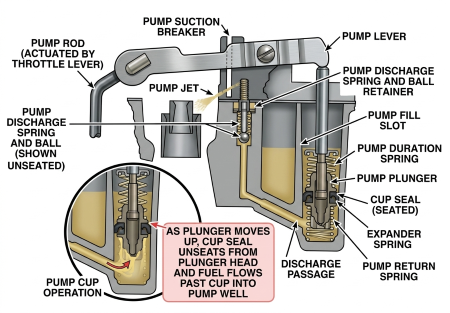
The Problem: Modern ethanol fuels dry out or "curl" the rubber cup seal. As shown in your diagram’s Pump Cup Operation inset, the cup must seat firmly against the plunger head on the downstroke to push fuel. If it’s worn, fuel just leaks past it back into the bowl instead of out the jet.
-
The Fix: Replace the plunger cup with Mike's Varajet carb kit, which is resistant to ethanol.
Pump Duration Spring
-
The Problem: Located between the pump rod and the plunger. Its job is to provide a controlled, sustained squirt rather than a single violent blast. If this spring is weak or broken, the fuel delivery is too fast and short, causing the engine to stumble after the initial "shot" is gone.
-
The Fix: Inspect the spring for tension or breakage during a teardown. It should be firm.
Pump Suction Breaker & Pump Jet
-
The Problem: The Pump Suction Breaker (labeled at the top of your diagram) is a vent that prevents fuel from being siphoned out of the pump jets at high highway speeds. If this is clogged with dirt or varnish, fuel can "dribble" into the engine constantly, causing a rich condition and leaving the pump well empty when you actually need it.
-
The Fix: Use a thin wire (like a guitar string) and carburetor cleaner to ensure the Pump Jet and the Suction Breaker vent are completely clear.
Discharge Check Ball & Spring
-
The Problem: Labeled as the Pump Discharge Spring and Ball. On the "up" stroke, this ball must seat to prevent air from being sucked into the system. If the ball is missing, stuck open by grit, or the seat is pitted, the pump will lose its prime and won't squirt.
-
The Fix: Remove the retainer, clean the ball and seat. Pro-tip: Place the ball in the hole and tap it lightly with a brass drift and hammer to "re-seat" the metal-to-metal seal.
3. How to Diagnose and Fix (Step-by-Step)
Step 1: The "Squirt Test" (Engine Off)
-
Remove the air cleaner.
-
Look down the primary barrel (the smaller one).
-
Manually move the throttle lever quickly.
-
Observation: You should see a strong, solid stream of fuel instantly. If it’s a "weak dribble" or there’s a delay, the circuit is failing.
Step 2: Clear the Passages
If you have fuel in the bowl but no squirt, the Discharge Passage or Pump Jet is likely clogged with varnish from old gas.
-
Fix: Remove the air horn (top cover). Spray carb cleaner into the pump well and blow it through with compressed air. Verify it exits the pump jet.
Step 3: Check the Pump Fill Slot
As your diagram shows, as the plunger moves up, the cup unseats to let fuel through the Pump Fill Slot.
-
Fix: If the well is dry even with fuel in the bowl, the fill slot or the "unseating" action of the cup is blocked. Clean the well and ensure the plunger moves freely on the shaft.
Step 4: Adjust the Pump Rod
If the squirt is late, the linkage might be bent or out of spec.
-
Fix: Most Varajets require the Pump Rod (actuated by the throttle) to be adjusted so the plunger is at a specific height at "curb idle." Carefully bend the rod to take up any "slop" or play in the linkage.
[!TIP] Safety First: When testing the squirt with the engine off, do not do it more than 2-3 times, or you will flood the engine. Always keep a fire extinguisher nearby when working with open carburetors.
