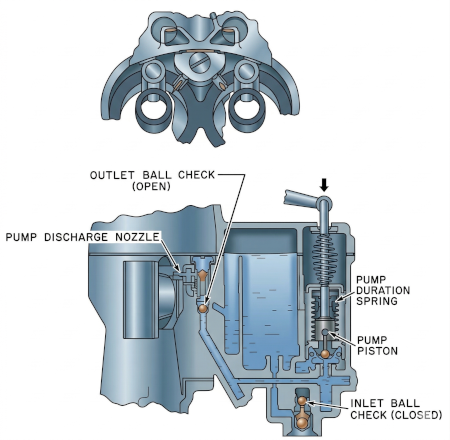
Accelerator Pump Circuit with rubber, or leather pumps.
As the throttle valves are opened, the accelerating pump piston is moved "DOWN" either by a pump lever or by a drop in vacuum above the piston to close the inlet ball check valve and force a metered quantity of extra fuel through the outlet ball check valve and pump discharge nozzle into the air stream.
With the return of the accelerating pump lever to the released position or the return to normal engine vacuum, the outlet ball check valve "CLOSES" while the inlet ball check valve "REOPENS", thus permitting fuel from the float chamber to enter and refill the accelerating pump cylinder.
Testing to See if Your Accelerator Pump is Working
Testing to See if Your Accelerator Pump is Working
One of the most common causes of a "stumble" or "hesitation" when you step on the gas is a failing accelerator pump. The purpose of this component is to provide a quick squirt of raw fuel into the venturi the moment the throttle plates open. This compensates for the sudden rush of air, preventing a lean condition before the main metering system takes over.
If your engine coughs or dies when you pull away from a stoplight, use the following steps to diagnose the pump.
1. Safety First
Before opening the hood, ensure the engine is off and cool to the touch. Work in a well-ventilated area away from open flames or sparks, as you will be dealing with open fuel. Keep a fire extinguisher nearby as a standard precaution when working on fuel systems.
2. Remove the Air Cleaner
To see into the throat of the carburetor, you must remove the air cleaner assembly.
-
Unscrew the wing nut on top.
-
Disconnect any vacuum hoses or breather tubes attached to the housing.
-
Lift the assembly away and set it aside.
3. Inspect the Carburetor Throat
With the air cleaner removed, look down into the "barrels" (bores) of the carburetor. If your engine has an automatic choke, the choke plate (the flat metal flap at the very top) may be closed. Gently push it open with your finger so you can see down toward the throttle plates.
4. Perform the "Squirt Test"
This is the most definitive test for an accelerator pump. Do not start the engine.
-
While looking down into the carburetor, manually move the throttle linkage (the lever connected to your gas pedal cable) to the wide-open position.
-
What to look for: You should see two strong, steady streams of liquid gasoline shooting from the accelerator pump nozzles directly into the center of the bores.
-
What a failure looks like: If the fuel merely drips, stutters, or doesn't appear at all, the pump is faulty.
5. Check the Linkage
If you didn't see a squirt, check the external mechanical linkage. Most accelerator pumps are operated by a rod or a plastic cam attached to the throttle lever.
-
Ensure the rod hasn't fallen off or become disconnected.
-
Check for a "dead spot"—if the throttle moves significantly before the pump arm starts to move, the linkage may need adjustment to take up the slack.
6. Analyze the Results
-
No Squirt, Linkage OK: This usually indicates a dried-out or torn pump diaphragm (or plunger cup) inside the carburetor. It could also mean the internal check ball is stuck or the fuel bowl is empty.
-
Weak Squirt: This often points to a partial clog in the small discharge nozzles or a pump diaphragm that is beginning to lose its seal.
-
Strong Squirt, Still Stumbles: If the pump is working perfectly but the engine still hesitates, the issue may be ignition timing, a vacuum leak, or the "pump shot" is mistimed and requires a different adjustment hole on the linkage.
Conclusion
If your test reveals a failing pump, most carburetors (like the Holley 2110 or Rochester 2G) allow you to replace the accelerator pump diaphragm or plunger by removing just the fuel bowl or the air horn, often without removing the entire carburetor from the engine. Refer to your service manual for the specific "pump stroke" measurements to ensure the new part is calibrated correctly.