
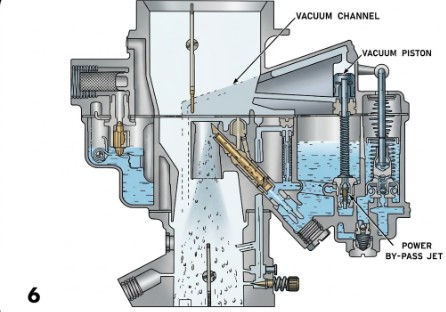
The Stromberg AAV series (a common two-barrel design) uses a vacuum-operated power circuit to provide the extra enrichment needed when the engine is under heavy load, such as during hard acceleration or hill climbing.
Based on the diagram you provided, here is the technical breakdown of how that system operates:
1. The Trigger: Manifold Vacuum
The entire system is controlled by the balance between manifold vacuum and spring tension.
-
At Idle or Cruising: Manifold vacuum is high. This vacuum is channeled to the top of the vacuum power piston (the assembly on the far right in your image). This high vacuum pulls the piston upward, compressing the power piston spring.
-
Under Load: When you open the throttle, manifold vacuum drops significantly. The vacuum is no longer strong enough to hold the piston up.
2. Activation of the Power Valve
Once the vacuum drops, the power piston spring takes over and forces the piston downward.
-
As the piston moves down, the rod attached to it makes contact with the power valve (also known as the economizer valve or bypass valve) located at the bottom of the fuel bowl.
-
The rod pushes a ball or pin off its seat, opening a secondary fuel passage.
3. Fuel Enrichment
With the power valve open, fuel flows through this auxiliary channel in addition to the fuel already coming through the Main Metering Jet.
-
This extra "slug" of fuel travels up to the Main Discharge Jet.
-
This results in a richer air-fuel ratio (roughly 12:1 or 13:1), which is necessary to produce maximum power and to keep the engine from overheating or "pinging" (detonation) under heavy load.
4. Returning to Cruising
As you let off the throttle and engine speed stabilizes, manifold vacuum increases again. This vacuum pulls the power piston back up, the spring is compressed, and the power valve closes. The carburetor then returns to its leaner "economy" mixture, where fuel is only supplied by the main metering jets.
Common Troubleshooting Tips for the AAV Power Circuit:
-
Stuck Piston: If the vacuum piston is stuck in the "up" position due to old fuel gumming up the cylinder, the engine will "lean out" and stumble when you step on the gas.
-
Ruptured Vacuum Channel: If there is a leak in the gasket or the vacuum channel, the piston will stay down all the time, causing the engine to run excessively rich at idle and cruise, fouling plugs and wasting fuel.
-
Power Valve Seat: If the ball check valve in the power valve doesn't seat properly, it will leak fuel into the circuit even when vacuum is high.
