
ROCHESTER B, BC, BV IDLE CIRCUIT
HOW IT WORKS

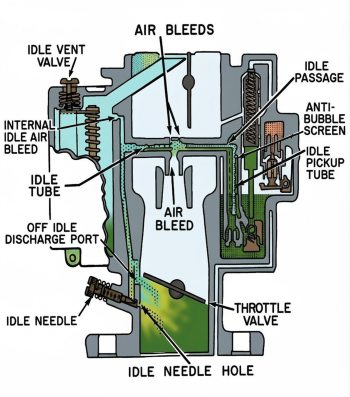
At idle speeds, the throttle valve is nearly closed so there is not enough air flow through the venturi to lift fuel from the float bowl. To supply enough fuel for idle and off idle requirements, an idle system is used. To make fuel flow, manifold vacuum is applied directly to the fuel in the bowl from the idle needle hole and the off idle port as the throttle valve is gradually opened. The idle system consists of the idle pick up tube, idle tube, idle passage, air bleeds, idle mixture needle, and idle discharge hole.
Atmospheric pressure acting on the fuel in the float bowl, forces fuel through the main metering jet into the main well. The fuel then travels up through the idle pick up tube and through the cross bar in the air horn. Air is then bled into the idle fuel at the center of the cross bar through the two top bleeds and the main nozzle. The air/fuel mixture then is picked up by the horizontal idle tube in the cross bar and metered through a calibrated restriction, then passes on into the vertical down channel where it is further bled with air by an internal air bleed in the verticle channel in the top of the float chamber. The air/fuel mixture continues downward past the off idle discharge port there more air is picked up to mix with the fuel mixture and then passes out the idle needle hole below the throttle valve. Here, the fuel mixture mixes with air coming past the slightly open throttle valve and passes into the engine as a combustible idle mixture.
On some applications an anti-bubble screen is used inside of the main fuel well. The purpose of the antibubble screen is to break up any vapor bubbles which might form in the main well during hot engine idle and disrupt proper fuel metering.
OFF-IDLE
As the throttle valve is opened slightly and engine speed increases, extra fuel is needed to combine with the additional air going by the throttle valve into the engine. This fuel is supplied by the off-idle discharge port. This supplies the fuel to the engine until air velocity is high enough in the venturi area to obtain efficient metering from the main metering system. Further opening of the throttle valve causes increased air flow through the carburetor bore, which causes pressure drop in the boost venturi sufficient to cause fuel delivery from the main nozzle. It should be remembered, however, that idle port discharge does not cease at this transfer point, but rather diminishes as the main nozzle discharge increases. Thus, the two systems interact and produce a smooth fuel flow at all engine speeds.
ADJUSTMENTS
Watch a video about our premium add-on kit, which includes tips on adjusting the idle mixture.
There are a couple of ways to adjust the idle mixture.
Using a vacuum gauge.
- Hook up the vacuum gauge to the intake manifold.
- Bring the engine to operating temperature.
- Adjust the idle screw to idle RPM as set by the manufacture.
- Adjust the idle mixture screw until you get the best vacuum reading along with a steady needle.
By ear.
- Bring the engine to operating temperature.
- Turn the adjusting screw out 1/4 turn.
- Start turning in the screw 1/4 turn at a time, wait a few seconds for the engine to catch up.
- Turn the screw in until the RPM starts to drop.
- Turn the screw counter clockwise 1/4 to 1/2 turn.
TROUBLESHOOTING
WON'T IDLE
Typically either a vacuum leak, lack of fuel, damaged idle mixture screw, or electrical system. We aren't addressing the electrical system here.
Vacuum leaks: could be around the mounting gasket, throttle body gasket, intake manifold, or any vacuum line leading from the carburetor. Spray carburetor cleaner around these places to see if the RPM smooths out, if it does you've found your leak.
Lack of fuel:
- Test the fuel pump. Should be around 4 - 4.5 lbs.
- Look for any kinked lines. If using rubber fuel hose it may be collapsed inside causing a restriction.
- Make sure the fuel filter is changed. There may be a filter inside the fuel inlet (on some models). Any inline filter should be changed.
- Did you adjust the idle mixture screw?
- Check the float to see if it drops enough to pull the needle out of the seat.
- Maybe the needle was damaged when installing and is sticking closed.
- Look at the idle passages in the illustration, then make sure each one is clear by blowing compressed air through them. You will need to determine the ending route of the passage so you can feel if any air is coming through. Simply blowing through a passage may not be enough to clear it. Ethanol residue leave hard deposits.
Damaged idle mixture screw: remove the screw and inspect carefully for damage to the threads or screw tip. Overtightening of the screw will force it into the carb body and damage the brass screw tip.
IDLE DISCHARGE (CAN CAUSE HESITATION)
This picture illustrates where the idle mixture discharge hole and the idle discharge holes are located. At idle the idle mixture comes from the idle mixture hole. As you throttle up, there is a short lag between idle & the accelerator pump circuit. This is where the idle discharge comes in. As the throttle valve opens, it exposes the idle discharge holes, allowing additional air/fuel mixture to enter the intake. These small passages can get plugged which will cause a slight hesitation off idle.

Watch a video about off idle hesitation here:
