
How It Works
The Basics: Why Vacuum Secondaries?
At low speeds or when cruising, the rear barrels (the secondaries) stay essentially closed. This forces the engine to draw all its air through the front barrels (the primaries). By keeping the airflow restricted to the primaries, the air velocity stays high, which keeps the fuel perfectly atomized and the engine running smoothly.
How They Open: The Need for Speed
When you step on the gas and engine speed increases, the primary barrels eventually max out their breathing capacity. Here is how the secondaries step in to help:
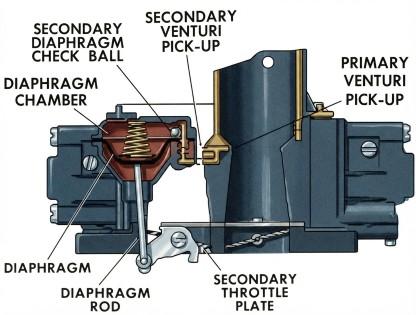
Building Vacuum: As air rushes rapidly through the primary and secondary barrels, it creates a vacuum in the venturis (the narrowest part of the carburetor throat).
Pulling the Diaphragm: This vacuum is routed to a housing on the side of the carburetor that contains a rubber diaphragm and a spring.
Opening the Plates: When the vacuum gets strong enough to overcome the pressure of the spring, it pulls the diaphragm up. The diaphragm pulls a lever, which starts opening the secondary throttle plates. The more air the engine demands, the stronger the vacuum gets, pulling the secondaries wider open.
The Check Valve: Preventing the "Bog"
If you floor the pedal and the secondaries snap open instantly, the engine would suddenly get a massive gulp of air before the fuel could catch up, causing a nasty hesitation or "bog." Holley prevents this using a tiny ball check valve inside the vacuum passage.
Controlled Opening: When you stomp the gas and vacuum spikes, the ball is violently sucked against its seat, blocking the main vacuum passage.
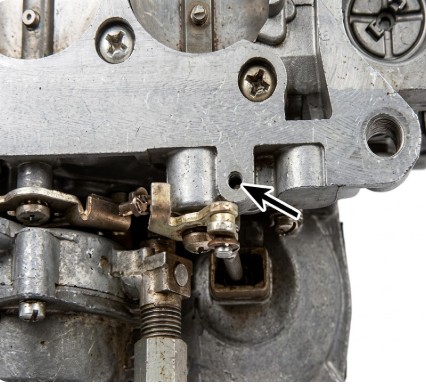
The Bleed Hole: The vacuum is forced to slowly bypass the ball through a tiny air bleed hole. This acts like a shock absorber, forcing the diaphragm to move slowly and allowing the secondaries to open at a smooth, controlled rate that perfectly matches the engine's air demand.
Fuel Delivery: As the plates open smoothly, air begins flowing past the secondary venturis, which pulls fuel from the rear metering system to keep the engine fed.
How They Close: Backing Off the Throttle
When you let off the gas and engine RPM drops, the carburetor needs to shut down the rear barrels instantly.
Releasing the Vacuum: As airflow slows down, the venturi vacuum drops. The check valve ball falls freely off its seat, allowing air to rush instantly back into the diaphragm housing.
Spring Action: With the vacuum gone, the diaphragm spring immediately pushes the linkage back down to close the plates.
Aero-Assist: The throttle plates themselves are mounted slightly off-center on their shafts. Because the "upstream" half of the plate is larger, the engine's manifold vacuum and the incoming air stream act like a heavy wind pushing against a door, helping to force the plates shut.
The Mechanical Failsafe
To ensure the secondaries never get stuck open, there is a hard mechanical link between the front and rear systems. A connecting rod attached to the primary throttle linkage rides inside a slotted hole on the secondary lever.
When you take your foot off the gas and the primary plates close completely, this rod physically grabs the secondary lever and forces the rear plates shut, keeping them locked out until you step on the gas again.
Tuning The Secondary
Tuning vacuum secondaries is about finding the exact balance point where the rear throttle plates open as quickly as possible without causing a hesitation or "bog."
If they open too fast, the engine gets a massive gulp of air before the fuel can catch up, causing the car to stumble and fall flat on its face. If they open too slowly, you are leaving horsepower on the table because the engine is starving for air.
Key insight: Holley color-codes their tuning springs by stiffness. The lighter the spring (like White or Yellow), the faster and sooner the secondaries open. The heavier the spring (like Brown or Black), the slower and later they open.
The Tuning Process
Proper tuning isn't done on a workbench; it requires putting a real-world load on the engine. You are looking for the absolute lightest spring your specific engine, gearing, and vehicle weight can handle.
Install a stiff spring to start, such as the Plain or Brown spring. This ensures you begin with a setup that definitely won't bog, giving you a smooth baseline. Get the vehicle up to a cruising speed in a high gear (e.g., 30 MPH in 3rd or 4th gear) and floor the accelerator. Pay close attention to how the engine responds as the RPMs climb and the secondaries transition open. If the acceleration is smooth but feels a bit sluggish or like the engine is holding back, swap to the next lightest spring in the kit (e.g., from Brown to Plain, or Plain to Purple). Repeat the test-and-swap process until you finally experience a noticeable stumble or hesitation when you floor it. You've now found the limit. Swap back to the previous, slightly heavier spring. That is your optimal tune.
Changing the Spring (The Bench Work)
Swapping the spring takes only a few minutes, but requires a gentle touch so you don't damage the internal rubber diaphragm.
Note: Pay attention to the four screws on the top lid. You do not need to remove the entire housing from the carburetor body to change the spring — just the lid.
Remove the Lid: Carefully unscrew the four Phillips head screws holding the top cover of the vacuum housing. Keep a finger pressed on the lid so the internal spring doesn't launch it across the garage.
Remove the Old Spring: Lift the lid straight up. The spring will sit right inside the cup of the rubber diaphragm.
Inspect the Diaphragm: Take a second to ensure the rubber diaphragm isn't torn, wrinkled, or pinched. Even a tiny pinhole tear means vacuum will leak out, and the secondaries won't open at all.
Install the New Spring: Seat the new spring squarely in the center of the diaphragm cup.
Reassemble: Place the lid back on. Tighten the four screws down evenly in a cross-pattern. Be extremely careful not to pinch the edge of the rubber diaphragm between the lid and the housing body.
Your 4160 doesn't have a secondary diaphragm attached to the side.
By design, standard Holley 4160 carburetors rely on a vacuum secondary assembly—consisting of a diaphragm housing, a rubber diaphragm, a spring, and an actuating rod—to open the secondary throttle plates based on engine airflow.
If your 4160 completely lacks a secondary diaphragm housing on the passenger side of the main body, it usually points to one of a few scenarios:
-
It's a Mechanical Secondary 4160 Variant: While less common than vacuum versions, some specialty or aftermarket 4160-style carbs are built with mechanical (linkage-actuated) secondaries rather than vacuum pods.
-
Converted or Omitted Housing: A previous owner may have removed the vacuum diaphragm housing, though leaving it open would create a massive vacuum leak unless the internal passage was sealed.
-
Confusion with the Metering Plate: Sometimes the vacuum pod is mistaken for the secondary metering system. Remember that 4160s use a plate (or sometimes a secondary metering block in specific models) in the fuel bowl area rather than removable secondary jets, which is separate from the vacuum diaphragm pod up top.
