
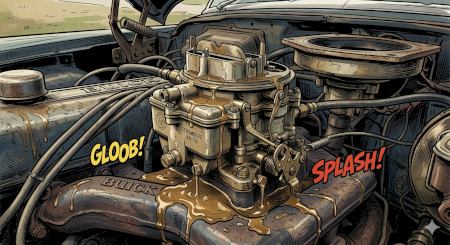
Troubleshooting a Stromberg 4A (often found on 1950s Buick Straight 8s and early V8s) requires a systematic approach, as these units are sensitive to fuel pressure and float height. Since this is a "square-bore" four-barrel design, you have two sets of floats and needles to manage.
Here are the primary causes and fixes for a flooding Stromberg 4A:
1. Fuel Pressure Issues
The Stromberg 4A was designed for low-pressure mechanical fuel pumps. Modern replacement pumps often put out 6–8 PSI, which is enough to overcome the needle and seat.
-
The Fix: Use a fuel pressure gauge to check the inlet pressure. If it is over 4.5 PSI, you must install a fuel pressure regulator. Aim for 3.5 to 4.0 PSI for optimal performance without flooding.
2. Float Level and Condition
The float level is critical on these models. If the floats are set too high, fuel will spill over the main discharge nozzles.
-
Setting the Height: The float level is typically measured from the gasket surface of the air horn to the top of the float. For many 4A models, this is 11/64" (check your specific year's manual).
-
Heavy Floats: These carburetors use brass floats. Over time, they can develop pinhole leaks and fill with gasoline, making them "heavy" so they don't rise to shut off the fuel.
-
Test: Remove the floats and shake them. If you hear liquid inside, they must be replaced.
-
3. Needle and Seat Contamination
Even a tiny speck of rust or rubber from a fuel line can prevent the needle from seating fully.
-
The Fix: Remove the needle and seat. Inspect the Viton tip of the needle for any grooves or debris. Blow out the fuel inlet with compressed air.
-
Tip: If you are using an older "all-metal" needle, consider upgrading to a Viton-tipped needle, which seals better against modern ethanol-blend fuels.
4. Power Valve (Economizer) Leak
The Stromberg 4A uses a vacuum-operated power bypass system. If the power valve gasket is leaking or if the valve itself is stuck open, it can dump excess fuel into the manifold, mimicking a "flooding" condition at idle.
-
The Fix: Ensure the power valve piston moves freely and that the seat is clean and sealing properly.
5. Porous Castings or Heat Soak
-
Heat Soak: If the flooding only happens after the engine is shut off, it may be "percolation." The heat from the intake manifold boils the fuel in the bowls, forcing it out of the vents.
-
Fix: Install a thick insulating carb spacer or heat shield.
-
-
Gasket Issues: Ensure the main body gasket is not "wicking" fuel or interfering with the float's movement.
