
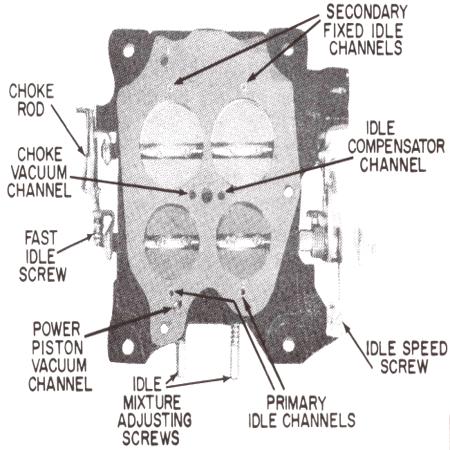
The Rochester 4 Jet throttle body has several machined holes and channels that each serve a specific function for fuel delivery, idle control, and vacuum operation. Here’s a breakdown of the key ones visible in your diagram and what they do:
Primary Idle Channels
-
These supply the fuel/air mixture to the engine during idle and just off-idle.
-
They connect from the idle mixture screws to the throttle bores, discharging just under the throttle plates.
-
If clogged, the engine will idle poorly or require excessive screw adjustment.
Idle Mixture Adjusting Screws
-
Control the amount of fuel/air mix entering through the primary idle channels.
-
Turning them in (clockwise) leans the idle mixture; out (counterclockwise) richens it.
-
They only affect idle and just off-idle operation.

Secondary Fixed Idle Channels
-
Feed a fixed amount of fuel/air mix to the secondary bores at low speed.
-
These are not adjustable — if they get restricted, secondary transition will stumble.
Idle Compensator Channel
-
Helps stabilize idle under certain loads or changes in manifold vacuum.
-
Often tied to temperature or accessory operation (varies by calibration).
Power Piston Vacuum Channel
-
Routes manifold vacuum to the power piston assembly.
-
When vacuum drops under load, the piston rises, enriching the mixture via the power system.
-
If blocked, the carb may run lean under acceleration.
Choke Vacuum Channel
-
Provides vacuum signal for choke pull-off operation.
-
Ensures the choke plate opens slightly as soon as the engine starts to prevent flooding.
Fast Idle Screw
-
Sets the higher idle speed when the choke is on during cold start.
Idle Speed Screw
-
Sets base throttle plate opening for warm idle speed.
-
Too far open can expose too much of the idle transfer slot, causing off-idle hesitation.
Tips for Checking Any Passage
-
Always test passages after soaking and brushing to ensure they’re truly open.
-
Use aerosol carb cleaner first, then compressed air to verify.
-
If cleaner sprays out of more than one exit, it often indicates a shared or branching passage.
-
If nothing comes out, reverse direction and test from the other end — some passages only flow in one direction due to check balls or restrictions.
