
Here is a rewritten, clearly organized version of the text:
Idle-Mixture Restrictors & Adjustment Procedure
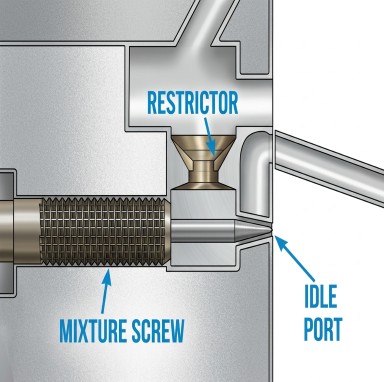
Overview of Restrictors The throttle body features fixed idle-mixture restrictors, similar to the design introduced on 1977 carburetors. These restrictors are small, non-removable brass plugs with precisely drilled holes.
Maximum Flow Control: The calibrated hole limits the maximum fuel mixture flow, preventing the mixture from becoming too rich regardless of how far outward the idle-mixture screws are turned.
Leaning the Mixture: To achieve a leaner idle-speed mixture, simply turn the mixture screws inward.
Inspection and Initial Setup
When servicing the throttle body, careful attention must be paid to the condition of the screws:
Remove Components: Take off the plastic limiter caps, then remove the idle-mixture screws and their springs.
Clean and Inspect: Examine the screw taper closely—it must be perfectly smooth. If the taper is grooved, ridged, or deformed, install a brand-new idle-mixture screw.
Seat the Screws: When reinstalling the screws and springs, use your fingers to turn the screws inward until they seat lightly. Do not overtighten.
Set the Baseline: As a starting point, turn both screws one full turn counter-clockwise from their seated position.

Final Adjustment on the Vehicle
Once the carburetor has been reinstalled on the vehicle, follow these final steps:
Adjust Mixture: Perform the final mixture adjustment according to the specific procedure outlined in your Service Manual.
Install Service Caps: Press the new red service-limiter caps over the screws.
Align the Tang: Ensure the limiting tang on the cap is positioned directly against the maximum rich stop.
Verify Fitment: Double-check that the caps are installed straight and pushed on until they are fully seated.
Turning the idle mixture screw inward (clockwise) will lean the mixture.
Here is the mechanical breakdown of why:
On traditional automotive carburetors, the idle mixture screws control the volume of fuel (or fuel-air emulsion) that is drawn into the engine at idle.
Turning IN (Clockwise) = Leans the mixture: As you thread the screw inward, the tapered tip moves deeper into the discharge port. This physically restricts the passageway, reducing the amount of fuel that can flow into the throttle bore. Less fuel means a leaner air-to-fuel ratio.
Turning OUT (Counter-Clockwise) = Richens the mixture: Backing the screw out opens the passageway, allowing a greater volume of fuel to flow past the tip, creating a richer air-to-fuel ratio.
