
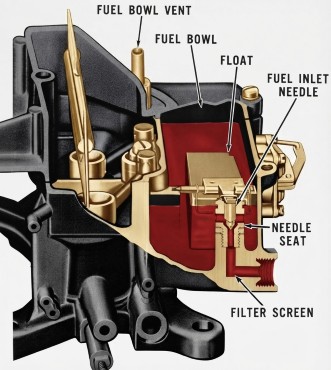
The fuel bowl on an Autolite/Motorcraft 2100 operates on a simple displacement principle — exactly like the float valve in a toilet tank. Its sole job is to maintain a precise, consistent reservoir of fuel for the main metering and idle circuits to draw from, regardless of engine load or fuel pump pressure.
The Core Components
The inlet system relies on three main parts working in mechanical tandem inside the front-mounted bowl:
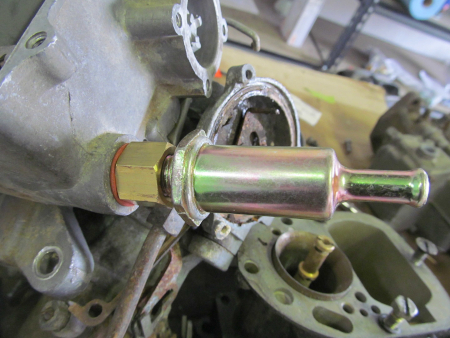
The Seat: A threaded brass fitting that screws directly into the carburetor body at the fuel inlet. It acts as the final gateway for fuel coming from the pump.
The Needle: A small, cylindrical plunger that rides inside the seat. On a 2100, these usually feature a Viton (synthetic rubber) tip to create a tight seal against the brass seat, though solid steel needles were used historically. Be careful not to damage the Viton tip. Too much pressure will cause a leak.
The Float Assembly: The 2100 typically uses a pontoon brass or Nitrophyl (black foam) float attached to a hinged arm. The float pivots on a retaining pin (the float shaft) secured inside the bowl.
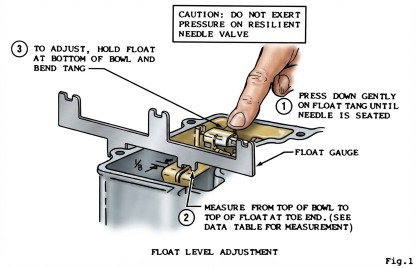 The measurement tool is no longer available. Use a metal ruler instead.
The Fuel Control Cycle
When the engine is running, the mechanical fuel pump supplies fuel to the inlet at a constant pressure (typically around 4.5 to 6 PSI for a classic Ford V8).
Filling: When the fuel level in the bowl drops, the float lowers. This pivoting action pulls the float arm away from the needle, allowing the fuel pump's pressure to push the needle off its seat. Fuel flows freely into the bowl.
Sealing: As the bowl fills, the float rises on top of the fuel. The metal tang on the back of the float arm pushes directly against the flat back of the inlet needle.
Equilibrium: Once the fuel reaches the specified level, the buoyancy of the float generates enough mechanical leverage against the needle to completely overcome the fuel pump pressure, pressing the Viton tip firmly into the seat and shutting off the flow.
As the venturis pull fuel out of the bowl under acceleration, the float continuously makes micro-adjustments — dropping slightly to let a little fuel in, then sealing again — keeping the wet level stable.
The Critical Tang Adjustment
The 2100's fuel level isn't fixed — it's adjustable, and the geometry is critical. If the level is too high, fuel can slosh or siphon over through the main metering jets or vent tubes, causing a rich condition, rough idle, or hot-start flooding. If it's too low, you risk uncovering the main jets during cornering or experiencing fuel starvation under heavy load.
You adjust the baseline level by carefully bending the small metal tang on the float arm that contacts the needle:
Bending the tang toward the needle closes the valve sooner, lowering the fuel level.
Bending the tang away from the needle allows the bowl to fill more before shutting off, raising the level.
