
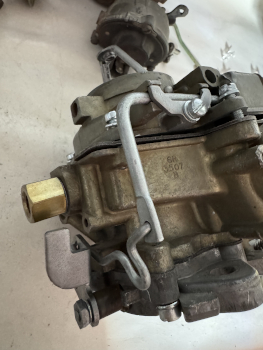
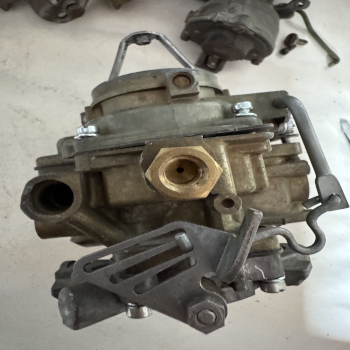
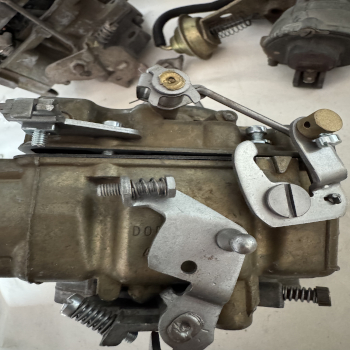
The Holley 1940 is a single-barrel, "economizer" style carburetor that was famously used as a service replacement for Ford's Autolite 1100 series on inline-six engines (like the 170, 200, and 250 Thriftpower).
The linkage on this carburetor is relatively straightforward but requires precise adjustment because many of the settings are achieved by manually bending metal rods or tangs rather than turning screws.
1. Key Linkage Components
-
Accelerator Pump Linkage: This connects the throttle lever to the accelerator pump diaphragm. It typically has multiple holes (slots) on the throttle lever to adjust the pump stroke for different seasons or performance needs.
-
Choke/Fast Idle Linkage: A metal rod connects the choke housing (automatic or manual) to the fast idle cam. When the choke is closed, this linkage pulls the cam into place, propping the throttle open slightly for a cold start.
-
Choke Unloader Tang: A small metal tab on the throttle linkage designed to "crack" the choke open when you floor the gas pedal (useful if the engine is flooded).
-
Fast Idle Cam Link: A thin rod that synchronizes the position of the choke plate with the fast idle speed screw.
2. Common Adjustments
Because these carburetors are often decades old, the linkage frequently needs "re-syncing."
3. Troubleshooting Linkage Issues
-
High Idle When Warm: Often caused by a sticky fast idle cam. If the linkage is gummed up with old fuel or dirt, the cam won't drop down when the engine warms up, keeping your RPMs high even when the choke is open.
-
The "Ford Stumble": If the accelerator pump linkage has too much "slop" (play), there will be a delay between you hitting the gas and the fuel squirt. Ensure the rod fits snugly in the lever holes.
-
Binding: Check the throttle shaft. On the Holley 1940, the throttle body is made of cast iron or aluminum, and the shaft can wear out the bore. If there is side-to-side play in the shaft, the linkage will bind and cause inconsistent idling.
4. Pro-Tip: The "Spark Control Valve" (SCV)
If you are using this on a pre-1968 Ford with a Load-O-Matic distributor, check if your Holley 1940 has a Spark Control Valve (a small brass hex-shaped valve on the side). If the carb doesn't have this valve, it won't provide the correct vacuum signal to your distributor, and the car will feel sluggish no matter how you adjust the linkage.
