
| Some of the Carter B&B 1 barrel downdraft and some Stromberg BXV, BXVD & BXVES have a dashpot built into the carburetor. This dashpot resides on the inside on the opposite side of the accelerator pump and is often mistaken as another accelerator pump because it looks like one. The dashpot is used on some vehicles with automatic transmissions. When letting up on the accelerator the dashpot will keep the throttle valve from completely closing long enough for the extra fuel to get burned in the engine. The complete dashpot is not manufactured, but our kits for these carburetors do include a repair kit to replace the leather cup. Instructions are as follows. | |
Place the dashpot in a vice (there should be a washer on top of the cup) as illustrated and using a drift punch beat the rod out of the cup. In some cases you will need to grind the peened over material on the end of the shaft. In this case drill a hole and insert a small self tapping screw to hold the new cup onto the shaft. Place the washer, cup and spring onto the rod. Put in a vice and press the cup onto the shaft. Use a 1/4" drive socket on the cup end so that it isn't damaged. If the cup fits loose you will have to drill a hole in the end and install a screw to hold the cup on. Be careful not to put too much pressure on the shaft. Bending it would not be good. Polish the dashpot well so that the cup glides smoothly. Put 2 small drops oil onto the cup before installing.  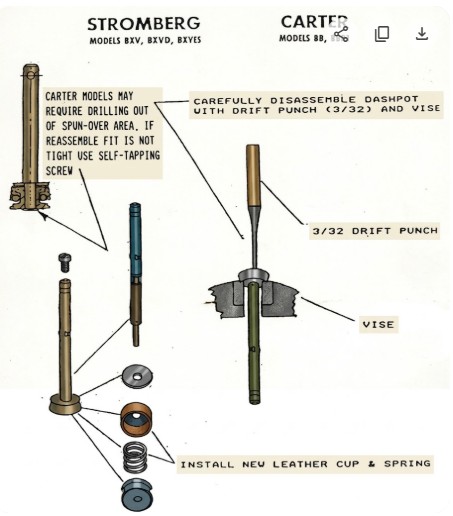 |
Dash-Pot (type 1)

When the engine is under load the piston #3 is in the up position and the well #4 if full of fuel.
When the throttle is released to go back to idle, the piston #3 returns to the down position. In order for this to happen the fuel must be discharged through the orifice #2.
The restriction at #2 retards the the closing of the throttle and avoids a too rapid of return.
The adjustment for the dash pot is at #1 and is normally set at 5 full turn out (counter clockwise)
Turning the screw further out will retard the idle return more. Too much will affect the shifting up of the transmission.
The transmission has to synchronize before shifting and if the RPM falls off too slowly when the throttle is released, gear change will be retarded.
Dash-pot (type 2)
The type 2 dashpot can be identified by a wire leading to the top of the carburetor.

This type of dashpot is controlled by a solenoid. When the engine is below 8 MPH in slow speed range, or under 15 MPH in high speed range, the transmission governor points close, which energizes the dashpot solenoid #3, through the electrical terminals #9. This raises the solenoid core #4, which permits the ball #7 to reach upper seat when piston #1 moves down. When the ball #7 is on it's seat, fuel is discharged through the restricted opening #6, causing the throttle valve to close quickly.
When the car is above 8 MPH in slow speed range, or above 15 MPH in high speed range, the transmission governors points are open and the solenoid #3 is not energized and the solenoid core #4 is held down by the spring #8, which prevents the ball #6 from seating. This allows free flow of fuel from the cylinder through passage #2 and fuel opening #5. This permits the dashpot plunger to operate freely without causing the throttle to close slowly. The slow closing of the throttle is not desirable above the speeds given, but is necessary at low speeds due to the action of the fluid drive.
